
Proxies for Scraping Bots - Scrape the Web Without Getting Blocked
Web scraping bots get blocked because every request exposes your IP. Rotating through a pool of residential, datacenter, or backconnect proxies gives your scraper a different identity on every request, bypassing rate limits, CAPTCHAs, and IP bans. Built for production pipelines that run at volume, around the clock, against targets that actively fight back.
Proxies for Scraping Bots - Scrape the Web Without Getting Blocked
What proxies do scraping bots use?
Web scraping bots route their requests through proxy servers to mask the origin IP and avoid detection. Without web scraping proxies, a scraper making thousands of requests from a single IP address gets blocked within minutes. By rotating through a pool of residential, datacenter, or backconnect proxies, scraping bots appear to come from different users in different locations, bypassing rate limits, CAPTCHAs, and IP bans.
Why Scraping Bots Need Proxies
Every website you scrape can see your IP address. When a server logs dozens of requests per second from the same IP, it treats that as automated traffic and blocks it. For a small one-off scrape, this is an inconvenience. For any production scraping operation pulling data continuously, it is a hard stop.
Proxies solve the problem by giving your scraper a rotating identity. Each request comes from a different IP, so from the server's perspective it looks like individual users visiting normally. This is how large-scale scraping operations stay functional against sites with aggressive anti-bot measures.
There are secondary benefits too. Geo-distributed proxy pools let you scrape localized versions of sites, collecting region-specific pricing, search results, or content that would otherwise be inaccessible from a single location. And since proxies act as an intermediary layer, your own servers and infrastructure stay out of any blocklists.
Which Proxy Type Is Right for Your Scraping Bot
The answer depends on what you are scraping, how frequently, and what your cost-per-IP budget is. Here is a practical breakdown.
Rotating Residential Proxies — Best for Protected Targets
Rotating residential proxies cycle through a large pool of IPs assigned by real ISPs to real household devices. Target sites see traffic that looks indistinguishable from organic visitors, which makes them the hardest proxy type to block. If you are scraping e-commerce platforms, social networks, or any site with sophisticated bot detection, rotating residential proxies give your scraper the best chance of getting through.
The tradeoff is cost. Residential proxies are priced per GB of traffic rather than per IP, so high-volume scrapers need to account for bandwidth usage in their cost model. For scrapers pulling large page payloads at high frequency, this adds up.
Use rotating residential proxies when scraping:
- Amazon, eBay, Shopify stores, and other e-commerce platforms
- Social media platforms with strong bot detection
- Travel and hotel booking sites
- Sites that fingerprint user agents and browser behavior
Datacenter Proxies — Best for Speed and Volume on Open Targets
Datacenter proxies sit on commercial server infrastructure and deliver fast, consistent connections at a fraction of the per-request cost of residential IPs. They are the right choice for scraping targets that do not aggressively block datacenter IP ranges: public APIs, news sites, government data sources, and many B2B databases.
At $1.11/IP with unlimited bandwidth, datacenter proxies make it economical to run scrapers at genuine scale. You can hold a static pool of dedicated IPs and rotate through them on a schedule, or use them as a cost-efficient base layer while reserving residential proxies for the more heavily protected targets in your pipeline.
Use datacenter proxies when scraping:
- Public datasets and open government portals
- News and media sites without aggressive anti-bot systems
- B2B directories and business databases
- Sites where speed matters more than IP trust level
Backconnect Proxies — Best for Continuous, Automated Pipelines
Backconnect proxies route every connection through a rotating gateway that automatically assigns a new IP from a large pool with each request. You connect to a single endpoint and the rotation happens in the background. This removes the complexity of managing your own IP rotation logic and makes them ideal for production scraping pipelines that run continuously without manual intervention.
The automatic rotation model means you never exhaust a fixed IP pool. For scrapers running 24/7 across hundreds of targets, backconnect proxies reduce operational overhead compared to managing lists of static proxies with manual rotation.
Use backconnect proxies when:
- Running continuous, automated data collection pipelines
- Scraping multiple domains simultaneously from a single connection
- You want rotation handled at the infrastructure level, not in your code
- Operating scrapers that cannot tolerate downtime from blocked IPs
Rotating Datacenter Proxies — Best for Budget-Conscious Scale
Rotating datacenter proxies combine the cost efficiency of datacenter infrastructure with built-in automatic rotation. A practical option for scrapers that need IP diversity at high request volumes but are operating on a tighter per-GB budget than residential allows.
ISP Proxies - Best for Mid-Tier Targets That Filter Datacenter Ranges
ISP proxies use IPs that are technically registered to Internet Service Providers but hosted on fast server infrastructure. They are harder to detect than standard datacenter proxies while being more affordable than residential options. A useful middle layer for targets that actively filter known datacenter IP ranges but do not deploy the full bot-detection stack that social media platforms use.
Common Scraping Bot Use Cases
Proxies do not care what your scraper is collecting. The same infrastructure that runs a price monitor runs a lead generation crawler or a news aggregator. Here are the most common applications.
Price monitoring.
Retail and travel scrapers pull pricing data from competitor sites continuously to feed dynamic pricing engines. Price monitoring at scale requires rotating IPs to stay live against major e-commerce platforms.
SEO and SERP tracking
Rank trackers and SERP scrapers query search engines from geo-distributed IPs to return accurate, localized results. Running these queries from a single IP gets flagged immediately. SEO proxies handle this use case specifically.
Competitive intelligence
Businesses scrape competitor product catalogs, pricing, job listings, and marketing content to inform strategy. This falls under competition monitoring and requires proxies capable of handling sites that actively protect their data.
Brand monitoring
Tracking brand mentions, review sites, and social platforms for reputation management means scraping at regular intervals across many sources. Brand monitoring keeps these crawlers running without interruption.
Ad verification
Ad tech platforms run scrapers that check ad placements, verify creative rendering, and detect fraud across publisher networks. Ad verification requires geo-distributed IPs to confirm regional targeting accuracy.
Lead generation
Sales teams and growth tools scrape business directories, LinkedIn, and company sites to build prospect lists. These scrapers need to handle anti-scraping measures on platforms that protect their data commercially.
Frequently Asked Questions About Scraping Bot Proxies
Frequently Asked Questions
What is the best proxy type for web scraping?
It depends on your target. Rotating residential proxies work best for sites with aggressive bot detection, such as major e-commerce platforms and social networks. Datacenter proxies are the most cost-effective for open targets without heavy anti-bot systems. Backconnect proxies are the simplest to operate at scale because rotation is automatic.
How many proxies do I need for web scraping?
A basic scraper hitting one or two targets can operate with a small pool of 10 to 50 IPs. Production pipelines scraping dozens of domains simultaneously benefit from rotating residential or backconnect proxies, where the underlying pool is large enough that individual IPs are rarely reused.
Will my scraper get blocked if I use proxies?
Proxies significantly reduce the rate of blocks, but they do not eliminate them entirely on sites with advanced bot detection. The key factors are proxy type (residential is hardest to detect), request frequency (too fast triggers rate limits regardless of IP), and request headers (scrapers that send clean browser-like headers get blocked less often than ones that send bare HTTP requests).
Do your proxies support Scrapy, Playwright, and Puppeteer?
Yes. All proxy plans support HTTP/HTTPS and SOCKS5 protocols, which are compatible with every major scraping framework including Scrapy, Playwright, Puppeteer, Selenium, and requests-based Python scripts. Authentication works via IP whitelist or username/password depending on your setup.
What is a backconnect proxy and how is it different from a rotating proxy?
A backconnect proxy is a single gateway endpoint that automatically routes each connection through a different IP from a large pool. A standard rotating proxy requires you to manage the IP list and implement rotation in your code. Backconnect proxies move the rotation logic to the infrastructure level, simplifying scraper architecture.
Can I target specific countries with your scraping proxies?
Yes. Residential and ISP proxy plans include geo-targeting by country, allowing you to route requests through IPs in specific regions. This is useful for scraping localized prices, region-specific search results, or content that varies by geography.

Buy Backconnect Proxies
Rotating IPs on every request. Scale scraping and automation without manual IP management.
More seo-marketing related use cases
Discord Proxies
Use our private proxy servers to unlock full potential in Discord for your products, services, and personal brand promotions. Get unparalleled anonymity and protection of your privacy with fast, secure connections that come with low ping.
Leverage the power of proxies to automate all your efforts on promotion with ease. Our services will help you conduct multi-accounting, create effective mailing lists that generate attention towards a larger audience across different social networks. Using our quality proxies, you can make use of specialized software or services without the thought of being banned by the spam systems of Discord.
Want to take your Discord activities to the next level? Use our private discord proxy servers and watch how your influence skyrocket while taking all necessary safety measures.
Price monitoring
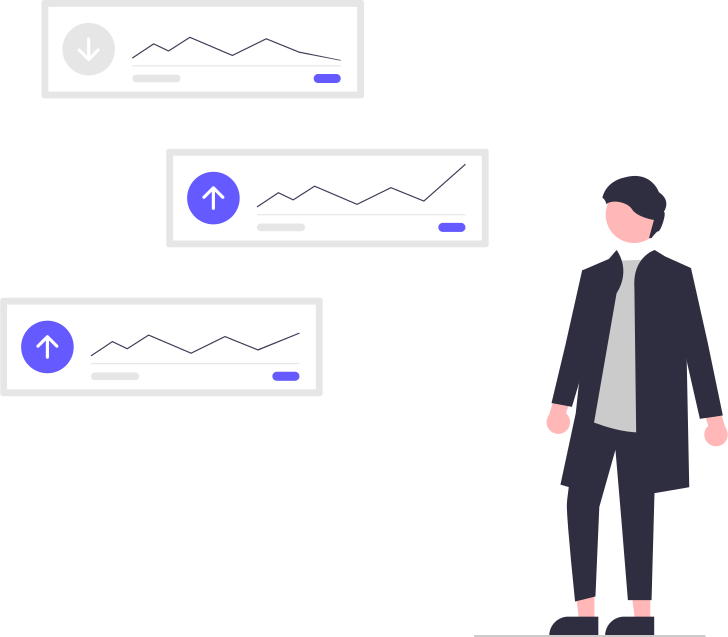
E-commerce prices change thousands of times per day. Tracking competitor pricing across product categories, regions, and platforms at any meaningful scale requires high-frequency automated requests. Proxies distribute that traffic across a large pool of IP addresses so your monitoring runs reliably within rate limits and returns accurate, region-specific data. This page covers which proxy type fits each price monitoring workflow and why.

Online gaming
A gaming proxy sits between your device and the game server, routing your connection through a dedicated IP address in the region you choose. That single change solves the problems every serious gamer runs into: high ping to distant servers, unfavorable P2P matchmaking routes, DDoS exposure on your home connection, and early access to titles launching in other regions first.
Unlike a VPN, which encrypts all traffic and adds overhead, a proxy routes your game traffic without encryption. That keeps latency low and throughput high — the two things that matter most in competitive play.
Anonymous browsing
Dedicated private IPs, obfuscated protocols, and zero-log infrastructure for browsing that leaves no trace.