
Open-source tools for proxy-powered workflows
A directory of the libraries, frameworks and CLIs we run in production, sponsor, or contribute to — every entry comes with a working proxy snippet.
Most "best open-source scraping tool" lists rank projects the author has never deployed at scale. This one is different. Every tool below is one we've either shipped to a paying customer, integrated with our proxy network, or sponsored on GitHub. No paid placements, no affiliate links.
The list is curated, not exhaustive and most of the projects presented are open source so we encourage you to participate and help us make it better. We add a project when we've used it in anger; we remove one when it stops being relevant.
ProxyMetrics - MITM proxy insights and audit tool
Self-hosted MITM proxy dashboard that creates, per vendor, intuitive dashboards which report spending, bandwidth, IP pool size and accuracy, error rates and much more
ProxyBench - Proxy checker and health monitor
Proxy checker and health monitor CLI - validate and benchmark HTTP, SOCKS5, and Shadowsocks proxies.
- Protocol support: HTTP, HTTPS, SOCKS5, Shadowsocks (ss://)
- Auto-detection: bare
host:portis probed automatically - Speed benchmarks: latency min/avg/p50/p95/max + loss rate
- Throughput measurement: optional large-file download speed test
- Geo-location: IP → country via embedded local database (no API)
- Output formats: human table, JSON, CSV
- No external runtime dependencies — single static binary

ProxyRotator - Smart rotating HTTP proxy
Smart rotating HTTP proxy - load-balance and auto-rotate a pool of upstream HTTP/SOCKS5 proxies with zero-drop connection draining, latency prioritisation, domain pinning, and a built-in management API.

- Rotates the active upstream on a schedule, after N requests, after too many errors, or on-demand.
- Drains gracefully — existing connections finish on the proxy they started on; new connections go to the new proxy immediately.
- Pins domains — once a session maps
example.comto proxy B, it stays there for the lifetime of the session (prevents breaking multi-step flows). - Prioritises speed — periodically measures latency and moves the fastest proxies to the front of the queue.
- Monitors health — optional background health checker removes dead proxies and re-adds them once they recover.
- Exposes an API — your crawler can report bad HTTP status codes (403, 429 …) and the rotator decides whether to rotate based on your thresholds.
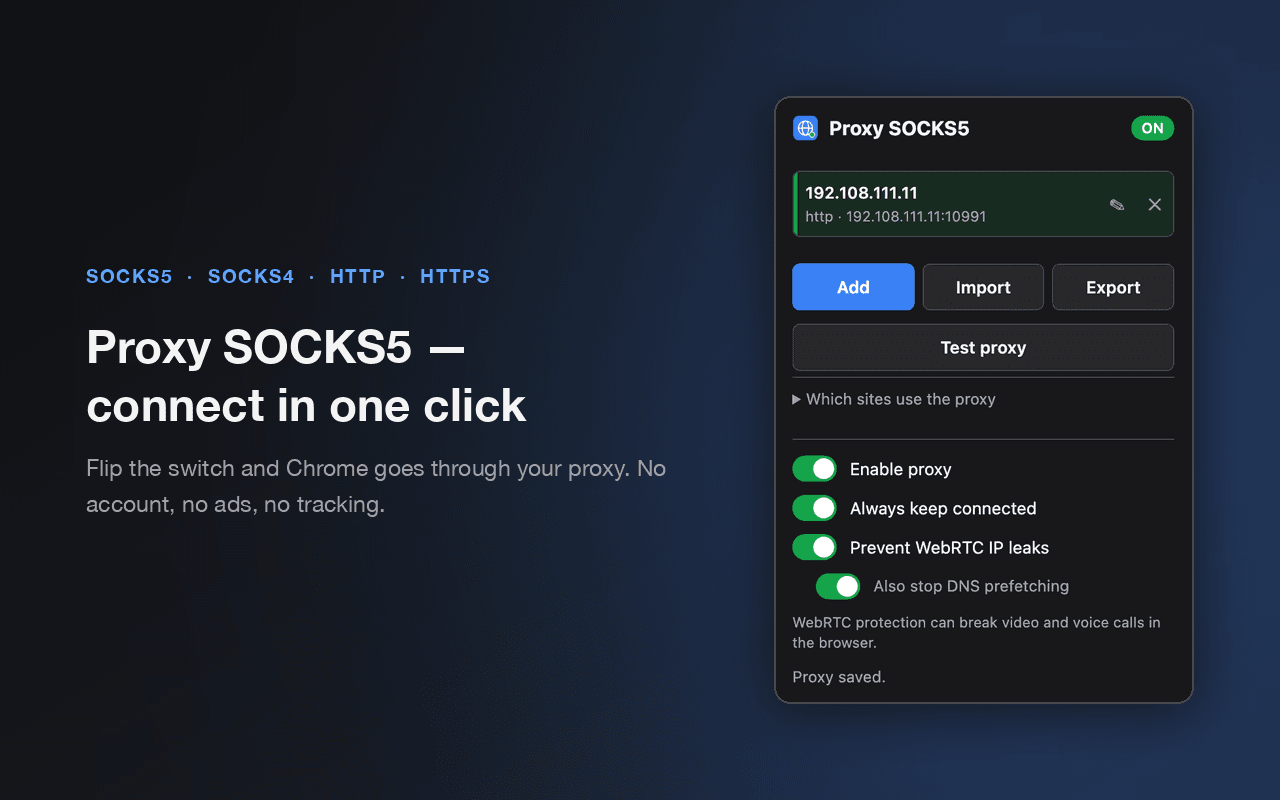
Proxy SOCKS5 - free Chrome extension
Proxy SOCKS5 is our free Chrome extension: add a proxy, flip the switch, and Chrome goes through it.
- Works with any SOCKS5, SOCKS4, HTTP or HTTPS proxy
- Paste your whole list at once and switch between proxies in one click
- Test button shows the exit IP, country and speed
- Proxy only the sites you choose, bypass the rest
- WebRTC leak protection
- Free, no account, no tracking