
What Is a Proxy Pool? How It Works, Types, and Use Cases
A single proxy can handle simple tasks, but it starts to break down when you need more scale, stronger reliability, or access to content across different locations. Once too many requests come from the same IP, websites may slow you down, limit what you can see, or block you altogether. A proxy pool solves that by giving you access to multiple IPs instead of just one, making traffic easier to spread and manage. In this article, you will learn what a proxy pool is, how does it work, what types exists and when it makes sense to use one.
Valentin Ghita
Technical Writer, Marketing, Research
Mihalcea Romeo
Co-Founder, CTO
What Is a Proxy Pool?
A proxy pool is a collection of proxy IPs that work together as one system. Instead of relying on a single proxy for every request, you use a pool that can draw from many IPs as needed.
The biggest difference between a proxy pool and a single proxy is simple. A single proxy gives you one IP address at a time. A proxy pool gives you access to many, without making you manage each one yourself. The provider handles that layer in the background, so you can focus on the task rather than the infrastructure.
That is what makes proxy pools so useful. They are not just a larger version of one proxy. They are a more practical way to manage traffic when consistency, rotation, and reliability start to matter. To see why, let’s look at what happens below when a request moves through a proxy pool.
How Does a Proxy Pool Work?
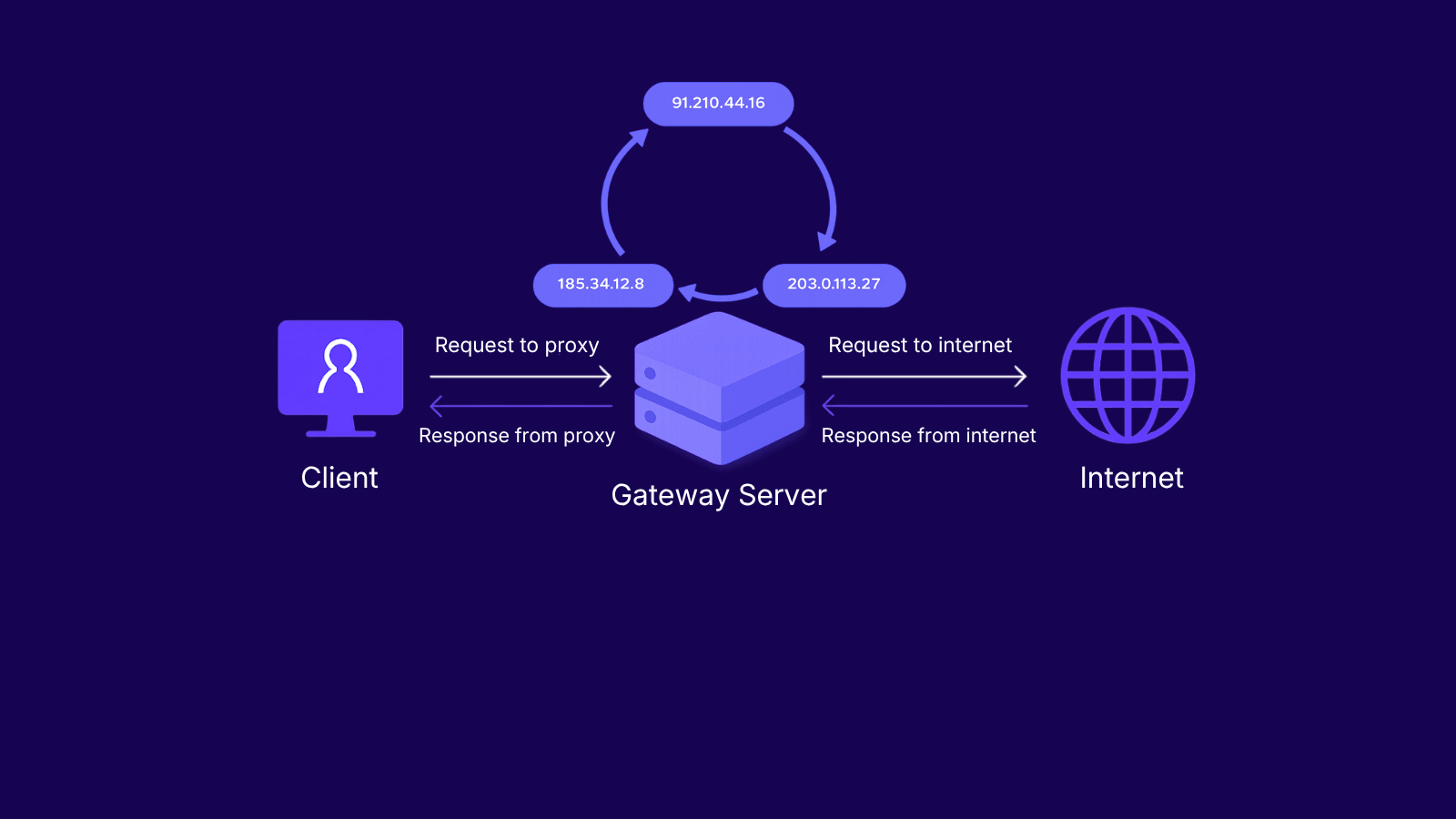
Most proxy pools work through one access point. You connect to it, send your request, and the system picks an IP from the pool to carry that request forward. You do not need to choose proxies one by one because that part is handled for you in the background.
How the IP is assigned depends on the setup. Some proxy pools can switch to a new IP every time you send a request, some at a set interval and some, besides these 2 options, also give you the option to hold an IP for a longer period of time. The last option is called sticky session and it can be really useful when a website expects a consistent user identity during login, cart activity, or multi-step flows.
A good proxy pool also manages IP quality in the background. It filters out weak or failing IPs, replaces bad routes, and spreads traffic more efficiently across the network. That is why proxy pools are usually easier to use than long manual proxy lists.
Why Use a Proxy Pool?
Reduce blocks and rate limits
One of the biggest reasons to use a proxy pool is to avoid putting all of your traffic through the same IP. When a website sees too many requests coming from one source, it can start limiting access, showing verification steps, or blocking the connection completely. With a proxy pool you can spread those requests across multiple IPs, which will make your traffic look more balanced and lowers the chance of running into quick restrictions.
Anonymity
Basically, with a proxy pool, you will add a layer of anonymity between the website and you. Instead of seeing your real IP, the site will see an IP from the proxy pool. Also, because traffic can be routed through different IPs, it is harder to connect all of that activity to one visible source.
Get around geo-blocks
Some websites and online services limit what you can access based on where you are. That can change what pages load, what products appear, or whether a service is available at all. A proxy pool helps by giving you access to IPs from different regions, so you can route traffic through the location you need and reach content that would otherwise be restricted.
Scale scraping and automation
One IP alone has its limitations, especially when it comes to how many requests it can handle before performance starts to suffer. This is where the problem begins if you wish to carry out web scraping or other automation tasks on a large scale. A proxy pool allows you to distribute requests among several different IPs rather than burdening one particular IP with your requests, and this will help you to lower the risk of rate limits and blocks almost to 0.
Types of Proxy Pools
Not all proxy pools work the same way. The biggest difference comes down to where the IPs come from, because that affects speed, cost, stability, and how likely a website is to treat the traffic as normal. In most cases, proxy pools fall into four main categories: residential, datacenter, mobile and ISP proxies.
Residential proxies use IPs connected to real home internet users. Because of that, they tend to look more like normal traffic, which makes them a strong choice for websites with stricter filtering or stronger anti-bot systems. The main downside is cost. They are usually more expensive than datacenter proxies, and their performance can vary more from one connection to another.
Datacenter proxy pools use IPs that come from servers and cloud infrastructure rather than household internet connections. They are usually faster, more affordable, and easier to scale, which makes them useful for larger workloads. The tradeoff is that some websites can block them pretty fast.
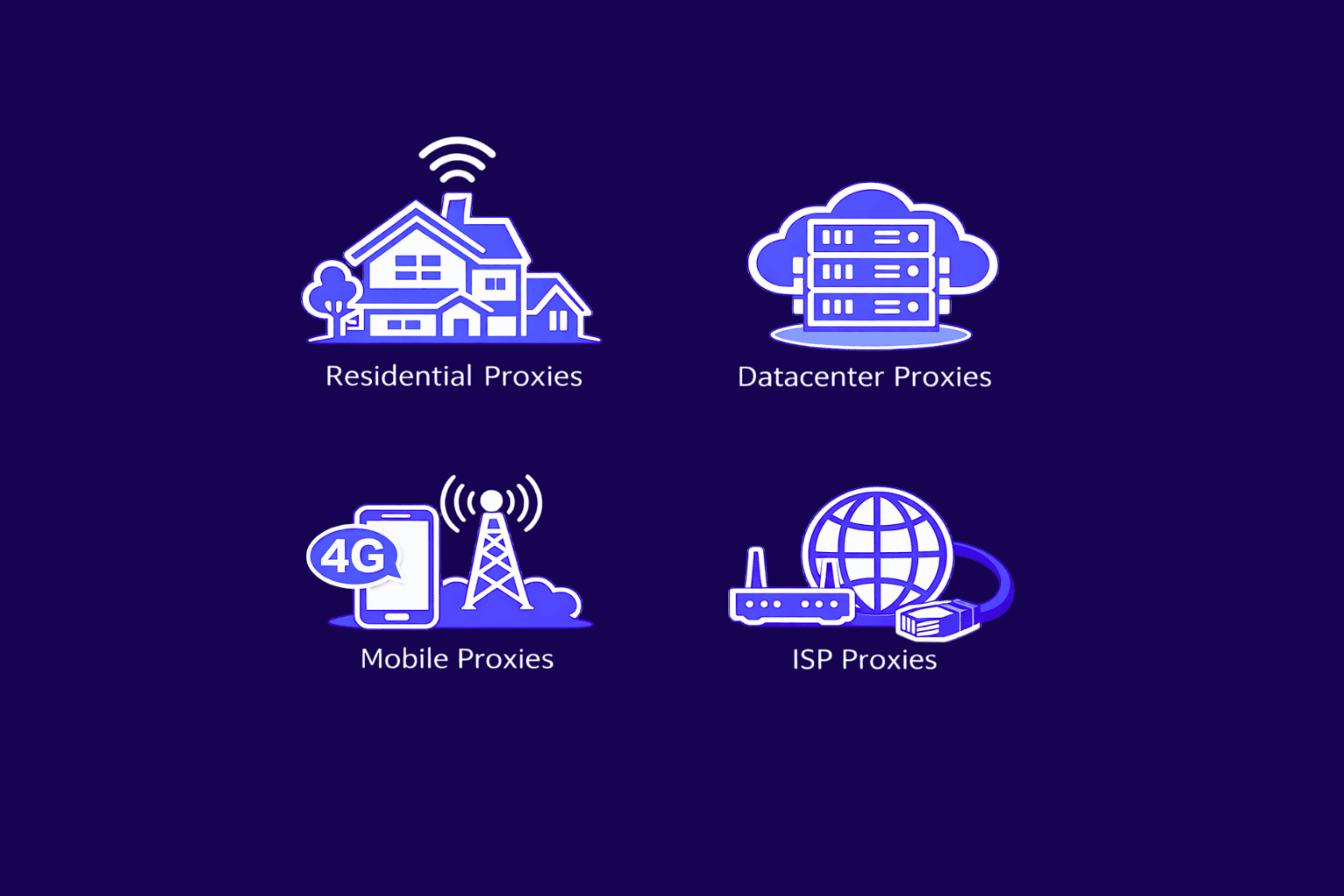
Mobile proxy pools use IPs from cellular networks. These IPs often have strong trust signals because many users can share the same carrier network ranges. That can make mobile pools effective against harder anti-bot defenses. They are a strong option when residential proxies still face resistance. The downside is price. Mobile proxies are usually the most expensive option, so they are often reserved for cases where lower-trust IP sources do not perform well enough.
ISP proxies, often called static residential proxies, sit somewhere between residential and datacenter options. They use ISP-assigned IPs but run on server infrastructure, which gives them a mix of stability and credibility. So, whenever you need the authenticity of a residential IP and the speed of a datacenter, they are a really good choice.
Limitations of Proxy Pools
Proxy pools can be very useful, but they also come with tradeoffs. Below, I'll explain you exactly what are some of these tradeoffs.
- A bigger pool does not always mean a better one. What matters most is IP quality. If the pool is filled with weak, abused, or unstable IPs, performance will still suffer no matter how large it looks on paper.
- Better proxies usually cost more. Residential, mobile, and advanced geo-targeted pools can get expensive quickly, especially for heavy or ongoing use. Lower-cost options often come with weaker reliability, less control, or lower-quality IPs.
- Too much rotation can work against you. Some tasks need the same IP to stay in place for a while. If the IP changes too often, it can interrupt logins, break sessions, or make activity look suspicious. That is why it is important to choose a provider that offers sticky sessions within the proxy pool.
- Speed is not the same across every proxy type. Residential and mobile proxies can be slower or less consistent than datacenter proxies. That does not make them worse. It just means each type fits different tasks.
- A proxy pool does not remove responsibility. It is still important to follow laws, platform rules, and ethical limits. A proxy pool is a tool for routing traffic, not a way around accountability.
Conclusion
As you've learned in this article, a proxy pool can give you a practical way to manage traffic across multiple IPs instead of relying on a single address. You can take advantage of it whenever you need better scale, to lower block risk and a broader location coverage.
Also, if you any questions about which proxy type can be good for your use case, feel free to contact our support team and they will help you with that.